
Kimi K2.7 Code: Is the $0.95 Code Specialist Worth It?
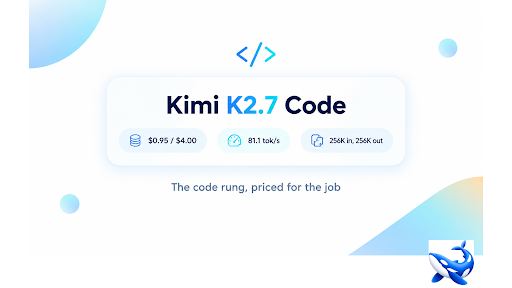
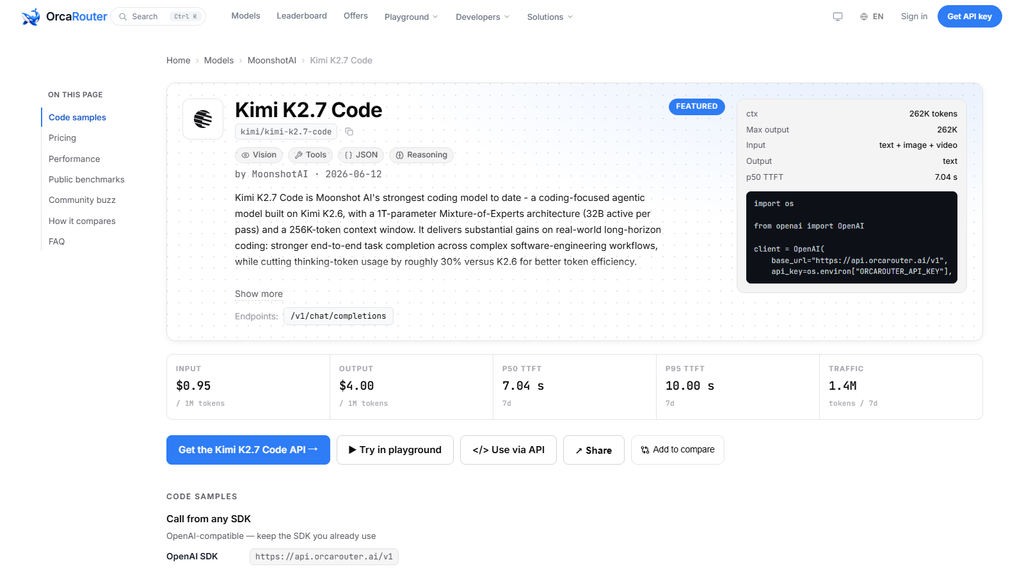
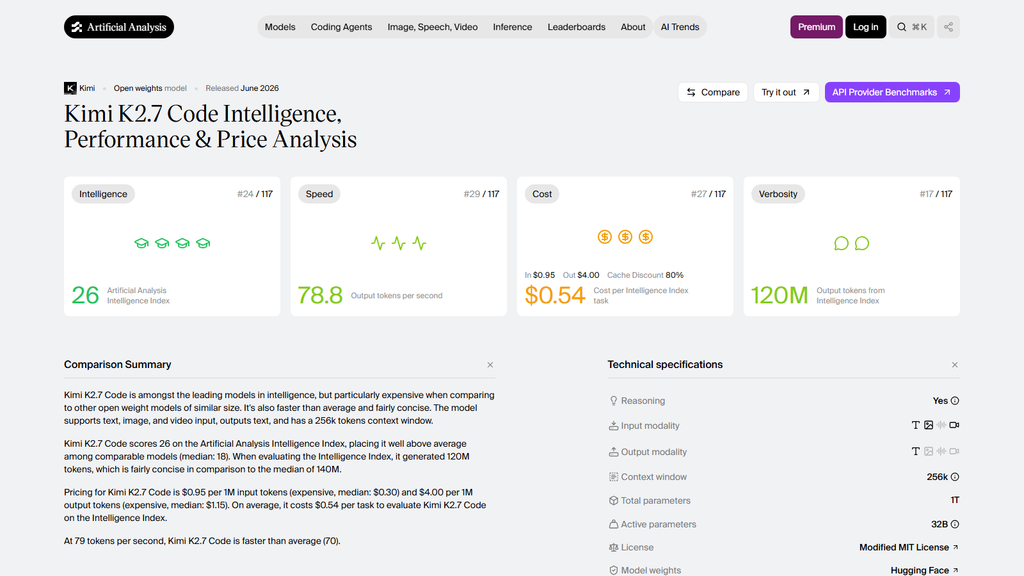
On OrcaRouter we host the Kimi K2.7 Code model — Moonshot’s code-specialized rung, shipped on June 12, 2026, priced at $0.95 per million input tokens and $4.00 per million output, with a 256K context window and a 256K maximum output. Artificial Analysis scores it 26 with an output speed of 81.1 tokens per second and a per-task cost of $0.54. In production its p50 time-to-first-token is 3.65 seconds and its seven-day token volume is 12.0 million. It is carried at list price on the same key as every other Moonshot model, with the live telemetry on the linked page.
A code card at a third of the flagship’s price is the easy pitch — and the honest question is whether the third of the price buys the same class of work. This article is about answering that.
The specialist’s arithmetic
The numbers that matter for a code card are the ones that decide how code actually gets generated: context, output, speed, and cost per task. Kimi K2.7 Code pairs a 256K context window with a 256K maximum output — a whole codebase file in, a whole generated file out, with no chunking seam in the middle. The 81.1 tokens per second output speed is nearly double the flagship’s 41.7, which for code is the difference between a streaming completion a human can follow and a wait that reads as broken.
The price is the other half of the arithmetic: $0.95 / $4.00 against the flagship’s $3 / $15, and a per-task cost of $0.54 against the flagship’s $2.00. The vendor prices the specialist at roughly a third of the generalist, and Artificial Analysis’ independent reading confirms the ratio holds on real tasks. That is the case for the card in one line: it streams code faster and costs a third as much, in exchange for a narrower ceiling.
The code rung between value and premium
| model | context | max output | input / output | AA index | output speed | per-task cost | 7-day tokens | p50 TTFT |
| Kimi K2.7 Code | 256K | 256K | $0.95 / $4.00 | 26 | 81.1 tok/s | $0.54 | 12.0M | 3.65 s |
| Kimi K3 | 1M | not listed | $3 / $15 | 44 (max) | 41.7 tok/s | $2.00 | 611.6M | 8.38 s |
| Qwen3.7 Flash | 1M | 64K | $0.03 / $0.13 | no page on AA | — | — | 746.3M | 3.83 s |
Context windows, output ceilings and rate cards are what the vendors list; the index scores, output speeds and per-task costs are Artificial Analysis’ live readings; the token volumes and TTFT figures are production telemetry from the linked pages. The table places the code rung where it actually sits: three times the price of the value floor, a third of the price of the generalist flagship, and an independent per-task cost that keeps the seat cheap in real use. The traffic column is the honest counterweight — 12.0 million weekly tokens against the flagship’s 611.6 million. The code card is not what moves Moonshot’s volume; it is what covers the niche.
The honest boundary of 26
The index reading is the part of the case this article will not oversell: 26 is not a top-rung score, and the card is not a ceiling generalist in code clothing. The specialist’s argument is narrower — a competent code score at a speed the generalist does not offer, priced for the volume of code work a team actually has. For the teams that buy it, the 26 is the accepted trade: the ceiling is mid, the output is fast, and the per-task cost stays low precisely because the score is not premium.
The production record keeps the boundary honest from the other side: a 3.65-second p50 first token and 12.0 million weekly tokens. The latency is respectable and unremarkable, and the volume says the market is buying the card for its role, not its rank. Reading both together — a 26 on the board and a niche volume on the meter — this article’s answer is that the score is exactly what a code specialist should be: good enough for the job, and priced like it.
The workload that makes it worth the $0.95
The verdict turns on the workload, and the workload is code-shaped. Whole-file generation over a 256K context, large diff production, codebase-scale completion where the output is measured in thousands of tokens — each leans on the 256K-in / 256K-out pair and the fast 81.1-token stream, and each is priced at a third of the flagship’s rate. For a team whose daily generation is this shape, the code rung is the rational buy, and the $0.95 input price makes the seat cheap enough to use freely.
The boundary is the workload that is not code-shaped. Generalist reasoning, long-form prose, anything that needs the quality ceiling the 44 (max) flagship exists to serve — the specialist is the wrong tool there, and the flagship rung is the seat. The 12.0 million weekly tokens on the linked page show the market drawing exactly this line: the code card is adopted for what it is, and this article’s advice is to do the same. If the job is code, $0.95 is a cheap seat to fill; if it is not, the generalist above it is where the money should go.
One arithmetic closes the case. A team that generates fifty thousand tokens of code output in a week — a real working team, not a toy workload — pays $0.20 at the code card’s output price against $0.75 at the flagship’s, and the input bill is a rounding error on both. Multiply that by a year of code-shaped work and the $0.95 rung pays for a second seat in the difference. Speed compounds the same way: at 81.1 tokens per second a twenty-thousand-token completion streams in about four minutes, where the flagship’s 41.7 would take nearly eight — a full code review’s worth of waiting saved on every large generation. Neither number changes the ceiling, and this article is not claiming it does; it changes the arithmetic of how much code work a team can afford to generate, which is the number the specialist was built to move.
The takeaway
Kimi K2.7 Code is Moonshot’s code-specialized rung: $0.95 / $4.00, a 256K context window and a 256K maximum output, an independent score of 26 at 81.1 tokens per second and $0.54 per task, and a p50 first token of 3.65 seconds on our production record. It streams code at nearly twice the flagship’s speed for a third of the price, and it carries a niche 12.0 million weekly tokens. The honest verdict follows the workload: for code-shaped work it is the rational buy at $0.95; for anything needing a higher ceiling, it is not. Buy the seat for the job it names — live at list price, with the telemetry on the linked page.
Sourcing note: release date, context window, output ceiling and rate card are what Moonshot lists and have not been independently reproduced. The Intelligence Index score, output speed and per-task cost are from Artificial Analysis’ live model page, read 2026-10-08. The p50 time-to-first-token and seven-day token volume are OrcaRouter production telemetry from the linked model page. All checked 2026-10-08.
